
9 Essential Tips for Selling a Business: How to Prepare and Protect Yourself From a Business Attorney
Selling a business is one of the biggest financial decisions an owner can make, and it often feels a little like trying to sell a house, run a marathon, and negotiate a peace treaty all at the same time. And unlike selling a used car, you cannot just vacuum the seats, spray some air freshener, and hope no one notices the weird noise it makes on left turns. Buyers will notice everything.
But here is the good news. With the right preparation, the right strategy, and the right professional support, you can turn a complicated process into a smooth and profitable transition. Whether you built your company from scratch or took it to the next level after acquiring it, selling your business is a major milestone. You deserve to walk away with confidence, clarity, and the value you worked so hard to create.
At Harbor and Main Law, we guide business owners through every stage of the sale process with clarity, strategy, and steady legal protection. Our office handles the details that most sellers do not even realize they need to think about, from structuring the deal to reviewing contracts to safeguarding your interests during negotiations.
Schedule a complimentary Consult: https://harborandmainlaw.com/contact/
Selling a business is too important to navigate alone, and our team makes sure you understand every step, avoid costly mistakes, and walk away with confidence. Whether you are preparing early or already in conversations with a buyer, we help you protect the value you have built and secure the cleanest, strongest exit possible.
This guide walks you through ten essential tips to help you prepare for a successful sale. You will also see where legal guidance becomes critical, because when selling a business, the decisions you make now will shape your future long after the ink dries.
The 9 Essential Tips for Selling a Business
1. Start Preparing Long Before You Plan to Sell
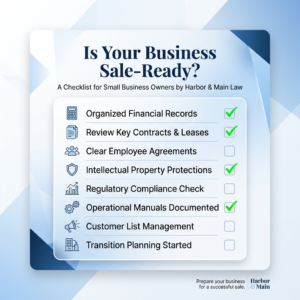
The most successful business sales do not happen quickly. They are the result of thoughtful preparation that begins months or even years before the business goes to market. Preparation includes:
Cleaning up financial records
Organizing contracts, leases, and vendor agreements
Ensuring corporate governance documents are in order
Addressing outstanding liabilities
Strengthening operational systems
Documenting processes and workflows
Buyers want a business that is stable, predictable, and easy to transition into. The more organized and transparent your operations are, the more attractive your business becomes. This includes ensuring your business’ valuable IP is preserved in advance of sale and ready for assignment after sale – https://www.uspto.gov/trademarks/trademark-assignments-change-search-ownership (USPTO on ownership assignment).
This is where a business attorney adds tremendous value. Long before a buyer appears, legal counsel can help you identify issues that could slow down or jeopardize a sale, such as outdated contracts, missing corporate documents, unassigned intellectual property, or compliance gaps that might raise red flags during due diligence. A business attorney can also help you clean up your internal structure, clarify ownership interests, and ensure your business is legally “sale ready”, which increases buyer confidence and strengthens your negotiating position. Early legal involvement prevents last‑minute surprises and positions you for a smoother, more profitable transaction.
2. Understand What Your Business Is Really Worth
Valuation is both an art and a science. Many owners overestimate the value of their business because they are emotionally invested in it. Others underestimate it because they do not realize how attractive their revenue model or customer base is to buyers. A professional valuation gives you a realistic starting point for negotiations and helps prevent leaving money on the table.
Buyers will scrutinize your financials during due diligence. If your books are incomplete or unclear, it will delay the sale or reduce your purchase price.
Before listing your business, make sure you have:
- Clean, reconciled financial statements
- Accurate tax returns for the past three to five years
- Updated profit and loss statements
- A clear breakdown of discretionary expenses
- Documentation of debts, liabilities, and obligations
A clean financial picture builds trust and speeds up negotiations.
3. Protect Confidentiality Throughout the Process
If employees, customers, or competitors learn about a potential sale too early, it can create instability. Employees may worry about job security. Customers may hesitate to sign new contracts. Competitors may use the information to their advantage.
To protect confidentiality:
- Require potential buyers to sign a nondisclosure agreement
- Limit access to sensitive information until buyers are vetted
- Use a broker or business attorney to communicate with buyers
- Avoid public announcements until the deal is finalized
A controlled, confidential process protects your business value and reputation. This is also an area where a business attorney provides significant protection. Legal counsel can draft a strong nondisclosure agreement tailored to your business, ensuring your financials, trade secrets, and customer relationships are fully protected. A business attorney also helps you manage the flow of information, verify buyer legitimacy, and avoid accidental disclosures that could weaken your negotiating position. By acting as a buffer between you and potential buyers, your business attorney helps maintain confidentiality, reduce risk, and keep the sale process stable and secure.
4. Prepare for Buyer Due Diligence
Due diligence is the buyer’s opportunity to verify everything you have represented about the business. It is also the stage where deals most commonly fall apart.
Buyers may request:
- Financial statements
- Tax returns
- Corporate governance documents
- Employment agreements
- Vendor and customer contracts
- Lease agreements
- Licenses and permits
- Litigation history
- Intellectual property documentation
The more organized and transparent you are, the more confident the buyer will feel. Legal counsel helps you anticipate what buyers will request, organize documents in a way that protects your interests, and ensure that disclosures are accurate, complete, and legally defensible.
A business attorney can identify red flags before the buyer does, such as outdated contracts, missing signatures, inconsistent governance records, or intellectual property that has not been properly assigned. They also help you avoid over‑disclosing information that could expose you to unnecessary risk or weaken your negotiating position. With a business attorney guiding the process, you present a clean, well‑structured due diligence package that builds buyer confidence and keeps the deal moving forward.
5. Work With an Business Attorney Early, Not at the Last Minute
Many business owners call an attorney only after they have found a buyer or received a letter of intent. By that point, key terms may already be locked in, sometimes in ways that disadvantage the seller.
An experienced business attorney helps you:
Structure the deal
Identify legal risks early
Review or draft the letter of intent
Ensure confidentiality protections
Prepare disclosures
Navigate regulatory requirements
Negotiate terms that protect your interests
Selling a business is a legal transaction with long term consequences. Bringing in legal counsel early ensures you are not unknowingly giving up rights or taking on liabilities.
6. Decide Whether You Want an Asset Sale or a Stock Sale
The structure of your transaction significantly affects your after-tax proceeds, future liability, and post-closing exposure.
Asset Sale
The buyer purchases selected assets of the business such as equipment, inventory, customer lists, intellectual property, and goodwill while typically leaving certain liabilities behind. Asset sales are common for small and mid-sized businesses because they allow buyers to limit assumed liabilities and “step up” asset basis for tax purposes.
Stock (or Equity) Sale
The buyer purchases the ownership interests of the company itself, stock in a corporation or membership interests in an LLC, and assumes the entity with its existing contracts, assets, and liabilities. Equity sales are more common in larger or more established companies, particularly where continuity of contracts and licenses is important.
How Structure Can Change Your Net Proceeds
Assume you sell your business for $2 million.
In an asset sale, the purchase price must be allocated among different asset classes. Amounts allocated to equipment or inventory may be taxed at ordinary income rates due to depreciation recapture, while goodwill may qualify for capital gains treatment.
If a significant portion of the price is allocated to assets taxed at higher ordinary income rates, your overall tax burden could increase substantially.
In contrast, in a properly structured stock (or equity) sale, the entire purchase price may qualify for capital gains treatment, potentially reducing your effective tax rate and increasing your after-tax proceeds.
A difference in tax treatment of even 10–15% on a multi-million-dollar transaction can mean hundreds of thousands of dollars in net proceeds.
That is why transaction structure and purchase price allocation is carefully analyzed and negotiated by prudent sellers before signing binding documents.
7. Negotiate With Strategy, Not Emotion
Owning a business is emotional, but sales negotiations require objectivity. You’ve built your company over years. That emotional investment can make it difficult to separate sentiment from strategy during negotiations. To negotiate effectively:
Know your bottom line
Understand your leverage
Be prepared for counteroffers
Avoid taking negotiations personally
Focus on long-term outcomes
But negotiation isn’t just about price. It’s about structure, liability, tax treatment, representations and warranties, non-compete terms, indemnification provisions, and post-closing obligations. A seemingly small concession can have significant financial or legal consequences long after the deal closes.
An experienced business attorney does more than review documents. Counsel can:
Assess the legal and financial risks behind each proposal
Identify unfavorable deal terms before they become binding
Structure the transaction to protect you from post-sale liability
Help you preserve deal value during high-pressure negotiations
Coordinate with accountants and advisors to optimize tax outcomes
Most importantly, an attorney allows you to stay focused on business objectives while ensuring the legal framework protects your interests.
8. Have an Attorney Review and Often Rewrite the Purchase Agreement
The purchase agreement is the most important document in the sale of your business. It defines not only the purchase price, but your legal and financial exposure for years after closing. It governs:
What assets or ownership interests are being sold
How and when the purchase price is paid
Representations and warranties
Indemnification obligations
Noncompete and nonsolicitation terms
Treatment of employees
Allocation of liabilities
Closing conditions
Post-closing obligations
In most transactions, the buyer’s attorney prepares the first draft. That draft is designed to protect the buyer, not you.
There is no such thing as a “standard” purchase agreement. Even small changes in wording can significantly expand or limit your liability. Indemnification clauses, survival periods, escrow provisions, and representations about financial statements or compliance with law can expose a seller to substantial post-closing claims.
A seller’s attorney ensures:
You are not assuming hidden or ongoing liabilities
Your representations are accurate, narrowly tailored, and time-limited
Indemnification exposure is capped and clearly defined
Payment terms are structured and enforceable
Noncompete provisions are reasonable and legally compliant
The written agreement reflects the business deal you actually negotiated
Without careful legal review and negotiation, a seller may unknowingly give up leverage, assume avoidable risk, or remain financially exposed long after the sale.
This is not a document to sign without experienced legal guidance.
9. Plan for Your Post Sale Transition
Many business sale agreements include a transition period during which the seller remains involved to train the buyer, introduce key customers, or provide consulting support. While this arrangement can increase deal value and smooth continuity, it also creates potential legal and financial exposure if not clearly defined.
Before closing, clarify in writing:
How long you will remain involved
Whether your role is employee, independent contractor, or consultant
The scope of your responsibilities
How and when you will be compensated
Whether compensation is fixed, hourly, or tied to performance or earn-outs
How much decision-making authority you will retain
What boundaries you want to establish with staff and customers
When your access to company systems and accounts will end
Without a clearly drafted transition agreement, disputes can arise over compensation, authority, performance expectations, or liability for post-closing decisions.
In some cases, sellers inadvertently retain fiduciary or operational exposure longer than intended. In others, poorly structured earn-out provisions lead to conflict when performance metrics are not clearly defined. A carefully structured transition plan protects both parties and reduces the risk of post-closing misunderstandings.
Final Thoughts
Selling a business is exciting, but it is also legally and financially complex.
The decisions you make during this process will affect your financial future, your reputation, and your peace of mind. Working with the right team, including a business attorney, CPA, and possibly a broker, ensures you are protected at every stage.
Harbor and Main Law helps clients navigate these decisions, reviewing documents, managing negotiations, and safeguarding your interests so you can move forward knowing every detail has been handled with care.
Contact our office and schedule a complimentary consultation to discuss how our business attorneys can help you maximize profits and minimize risks when selling your business.