
Outside general counsel for Naperville and Chicagoland businesses
The Complete Estate Planning Guide for Illinois Business Owners
For Illinois small and mid-sized business owners: LLCs, corporations, partnerships, and family businesses
Build Your Estate Plan with Harbor and Main Law
Schedule a confidential estate planning consultation to discuss how your business, ownership structure, and succession goals fit together under Illinois law.
Call Us
This guide is general educational information, not legal advice. Estate planning and business succession issues depend heavily on individual facts, business structure, family dynamics, and tax considerations. Reading this article does not create an attorney-client relationship. Illinois business owners should consult a qualified Illinois estate planning and business attorney before implementing any plan.
Why Estate Planning Is Different for Illinois Business Owners
If you own a business in Illinois, your estate plan is not just about your house, bank accounts, or personal belongings. It is also about continuity, control, and protecting value—for your family, your partners, your employees, and the business you’ve worked years to build.
Business owners face risks that employees and non-owners simply don’t:
- No clear successor named to run the company
- Ownership interests tied up in Illinois probate court
- Partners or family members fighting over control
- Employees unsure who has authority to sign checks or contracts
- Forced liquidation of the business to pay expenses or taxes
- A disabled owner with no one legally authorized to act
These risks are not theoretical. They happen every day—often because a capable, responsible business owner never had time to “get around to” estate planning or assumed a basic will was enough.
For Illinois business owners, estate planning is about keeping the business operational, protecting family wealth, and preventing chaos at the worst possible moment.
What Is Estate Planning for Business Owners?
Estate Planning, Explained Simply
At its core, estate planning answers four questions:
- Who controls my assets if I’m incapacitated?
- Who receives my assets when I die?
- How and when do they receive them?
- Who is legally authorized to carry out my wishes?
For business owners, those questions apply not only to personal assets—but also to business ownership, management authority, and cash flow.
General Estate Planning vs. Business-Owner Estate Planning
A standard estate plan might address:
- A will
- A power of attorney
- Guardians for minor children
- Beneficiaries for personal assets
Business-owner estate planning goes further. It integrates your personal estate plan with:
- Operating agreements or shareholder agreements
- Buy-sell agreements
- Business succession plans
- Key person insurance
- Valuation and liquidity planning
Without this coordination, even a well-intentioned estate plan can conflict with business documents and create legal and operational problems.
Estate Planning Documents for Illinois Business Owners
Wills and Trusts for Business Owners
What a Will Does
In Illinois, a will:
- Names an executor to administer your estate
- Directs how probate assets are distributed
- Can include guardianship provisions for minor children
What a Will Does Not Do
A will does not:
- Avoid probate
- Automatically transfer business interests smoothly
- Control assets with beneficiary designations or trust ownership
Special Considerations for Business Owners
If your business interest passes through your will:
- It may be frozen during probate
- The executor may lack industry or management experience
- Partners may suddenly find themselves dealing with heirs
A will alone is rarely sufficient for owners of closely held businesses.
Revocable Living Trusts
How Revocable Trusts Work
A revocable living trust is an entity you create during your lifetime. You typically:
- Serve as trustee while alive and competent
- Transfer ownership of assets (including business interests) into the trust
- Name a successor trustee to step in upon incapacity or death
Why Business Owners Use Trusts
For Illinois business owners, revocable trusts can:
- Avoid probate for trust-owned assets
- Maintain continuity of ownership
- Provide privacy (trusts are not public court filings)
- Allow immediate authority if the owner becomes incapacitated
Trusts and Business Continuity
If your ownership interest is held in a trust, your successor trustee can often:
- Vote shares or membership interests
- Sign contracts
- Oversee distributions
without waiting for a court appointment.
Powers of Attorney
Financial Power of Attorney
An Illinois financial POA allows someone you choose (your “agent”) to manage financial and business matters if you cannot.
For business owners, this document is critical. Without it:
- No one may have authority to sign checks
- Payroll may stop
- Contracts may lapse
- Banks may freeze accounts
A properly drafted POA should explicitly address business authority, not just personal finances.
Health Care Power of Attorney and Advance Directives
These documents:
- Appoint someone to make medical decisions
- Communicate your preferences regarding treatment
While not business documents, incapacity planning is incomplete without them.
Other Key Documents
HIPAA Authorizations
Allow trusted individuals to receive medical information.
Living Wills
State preferences regarding end-of-life care.
Beneficiary Designations
Life insurance, retirement accounts, and payable-on-death accounts pass outside of a will or trust unless they are coordinated carefully.
Failing to align these with your estate plan is a common and costly mistake.
Probate and Probate Avoidance in Illinois
What Is Probate?
Probate is the court-supervised process of administering a deceased person’s estate. In Illinois, probate can involve:
- Court filings
- Notice requirements
- Creditor claims
- Delays in asset distribution
Why Business Owners Often Want to Avoid Probate
Probate may:
- Delay decision-making authority
- Freeze business assets
- Create uncertainty for partners and employees
- Increase administrative costs
How Estate Planning Affects Probate
- Wills: Assets still go through probate
- Trusts: Trust-owned assets generally avoid probate
- Beneficiary Designations: Bypass probate if properly structured
For business owners, avoiding probate is often about operational continuity, not just convenience.
Special Considerations for Business Owners
Business Succession Planning
Succession planning answers:
Who will own the business?
Who will manage the business?
When and how will transitions occur?
Ownership and management are often, and mistakenly treated as the same thing. They are not.
An effective estate plan separates:
Economic benefit (who receives value)
- Control (who makes decisions)
Buy-Sell Agreements
A buy-sell agreement governs what happens when an owner exits due to:
- Death
- Disability
- Retirement
- Divorce
Key functions include:
- Setting valuation methods
- Providing liquidity
- Preventing unwanted owners
Funding mechanisms may include:
- Life insurance
- Disability insurance
- Installment payments
Your estate plan should work with, not against, your buy-sell agreement.
Family Businesses and Blended Families
Family businesses raise unique challenges:
- Some children active in the business, others not
- Second marriages and blended families
- Fairness versus equality
Tools often used include:
- Voting and non-voting interests
- Trusts holding ownership interests
- Life insurance to equalize inheritances
Without planning, family conflict can destroy both relationships and the business.
Tax and Asset Protection Considerations (High Level)
Most Illinois estates are not subject to federal estate tax, but:
- Illinois has its own estate tax threshold
- Business value can push estates into taxable territory
- Poor liquidity planning can force asset sales
Advanced planning may involve trusts and other strategies—but these require individualized advice.
Practical Planning Steps for Illinois Business Owners
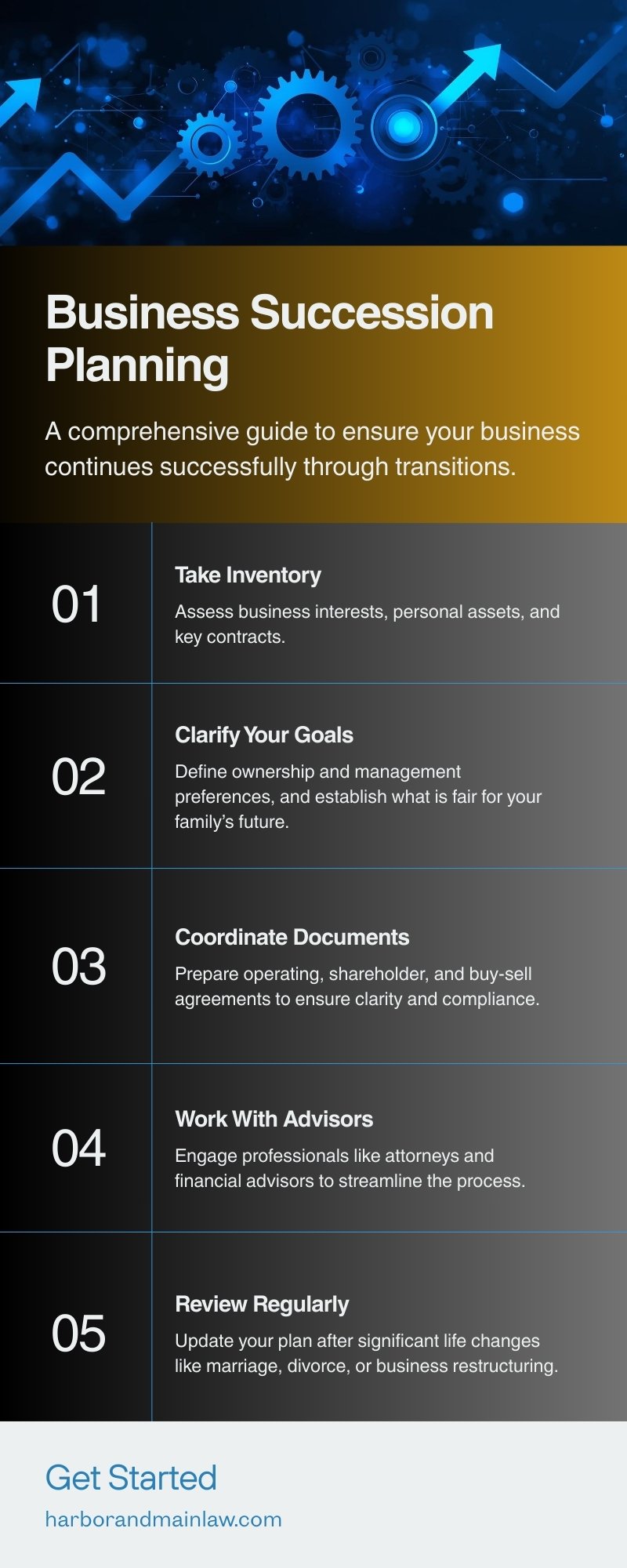
Step 1: Take Inventory
Business interests
Personal assets
Debts
Key contracts and agreements
Step 2: Clarify Your Goals
Who should own the business?
Who should manage it?
What is “fair” for your family?
Step 3: Coordinate Business Documents
Operating agreements
Shareholder agreements
Buy-sell agreements
Step 4: Work With the Right Advisors
Illinois estate planning and business attorney
CPA or tax advisor
Financial advisor or insurance professional
Step 5: Review and Update Regularly
Update after:
Business growth or restructuring
New partners
Marriage or divorce
Birth of children
Sale or acquisition
Common Estate Planning Mistakes to Avoid
- Relying solely on an online will
- Ignoring the business in estate planning
- Failing to update documents after major changes
- Misaligned beneficiary designations
- No incapacity planning
Protect What You’ve Built
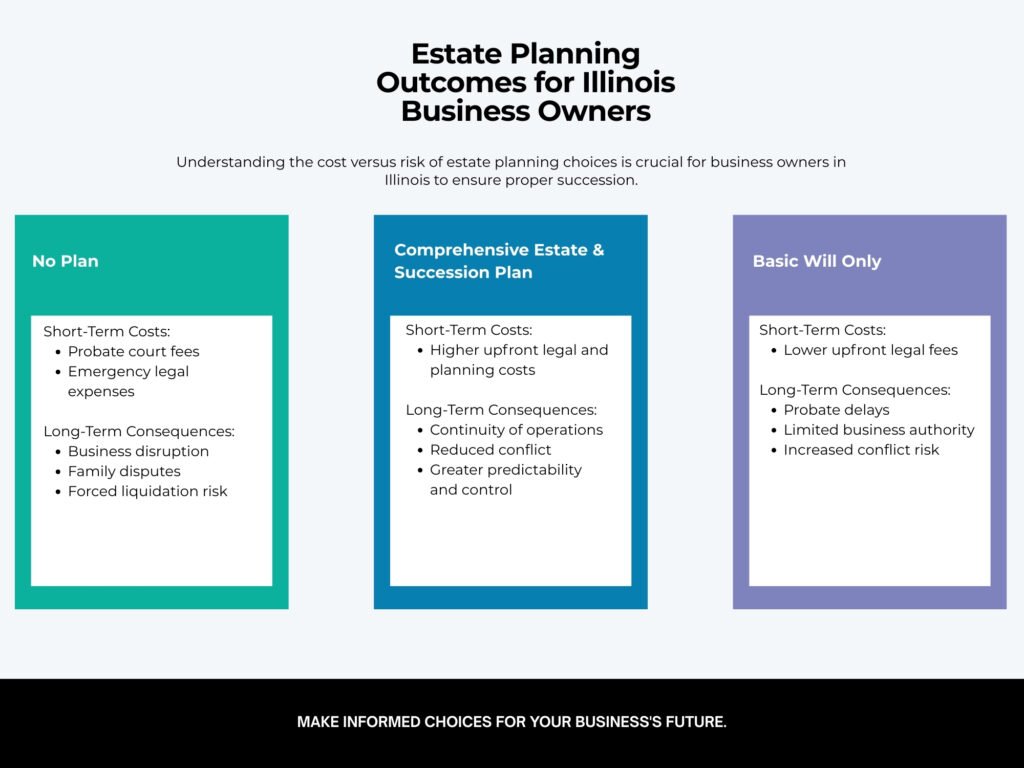
For Illinois business owners, estate planning is not about preparing for death—it is about protecting life’s work.
A coordinated estate and business succession plan:
- Protects your family
- Provides clarity to partners and employees
- Preserves business value
- Reduces conflict and uncertainty
If you own a business in Illinois, estate planning is not optional. It is a responsibility.
The next step: Schedule a consultation with an Illinois estate planning and business attorney who understands both sides of your world, personal and professional.
Frequently Asked Questions
Estate Planning for Illinois Business Owners
Do I really need an estate plan if I already have a will for my Illinois business?
Yes. A will alone does not address business continuity, incapacity, or coordination with operating and buy-sell agreements.
What happens to my business if I die without a will or trust in Illinois?
Illinois intestacy laws control distribution, and the business may be tied up in probate, creating delays and uncertainty.
Should my business ownership go into my revocable living trust?
Often yes, but it must be coordinated with your business documents and partner agreements.
How does a buy-sell agreement fit into my estate plan?
A buy-sell agreement provides liquidity and control, while your estate plan ensures proceeds are distributed as intended.
Can my power of attorney run my business if I’m incapacitated?
Only if the POA explicitly grants business authority and aligns with company documents.
How often should Illinois business owners review their estate plans?
At least every 3–5 years, and after any major life or business event.
What’s the difference between personal estate planning and business succession planning?
Personal planning focuses on family assets; succession planning focuses on ownership, control, and continuity of the business.
How do I choose the right trustee, executor, or successor for my business?
Choose individuals with integrity, competence, and the ability to work with professional advisors—not just family ties.
Schedule a Complimentary Consultation
Get clarity on how Illinois estate planning works for business owners—and what documents matter most for your company’s continuity.